Research

My research focuses on dark matter, dark energy, modified theories of gravity, the cosmological constant problem, cosmological tensions, and the physics of the primordial Universe.

Research highlights

Partial geometrization of dark matter in metric f(R) gravity: Exact reconstruction and growth constraints

D. Campanella Galanti and O. F. Piattella, Partial geometrization of dark matter in metric f(R) gravity: Exact reconstruction and growth constraints, arXiv:2610.30201 (2026).

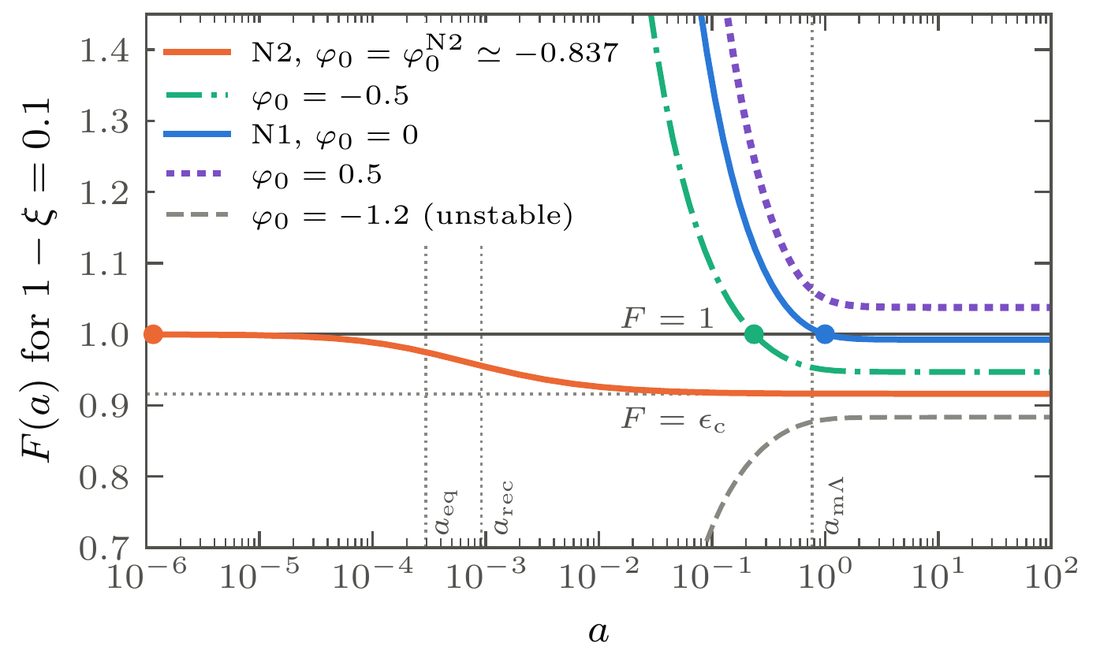
The function F(a), which sets the effective gravitational coupling G/F, for a geometrized fraction of 10%: no stable reconstruction recovers General Relativity (F = 1) both at early and at late times.

How much dark matter can geometry replace? With PhD student Davide Campanella Galanti, we asked what fraction of dark matter a stable metric f(R) theory can account for while reproducing the ΛCDM expansion exactly. The reconstruction is exact and linear, but geometrization always makes the effective gravitational coupling run. Growth-rate data allow at most 10⁻³–10⁻² of the dark matter to be geometric, and local tests of gravity far less.

Dark Coriolis fields

G. Bianchi, F. Re and O. F. Piattella, Dark Coriolis fields, Eur. Phys. J. Plus 141 (2026) 275.

We explored whether part of the phenomenology usually attributed to dark matter in disk galaxies could instead arise from a non-Newtonian gravitational field. Within Newton–Cartan gravity, we found Coriolis-field configurations capable of supporting the characteristic rotation profiles of galaxies, from the central bulge to the approximately flat outer region. These ‘dark Coriolis fields’ can also be understood as the leading contribution of the time-space components of the metric in a non-conventional post-Newtonian expansion of General Relativity.

The matter with(in) CPL

L. Giani, R. von Marttens and O. F. Piattella, The matter with(in) CPL, Open J. Astrophys. 8 (2025), DOI: 10.33232/001c.142699.

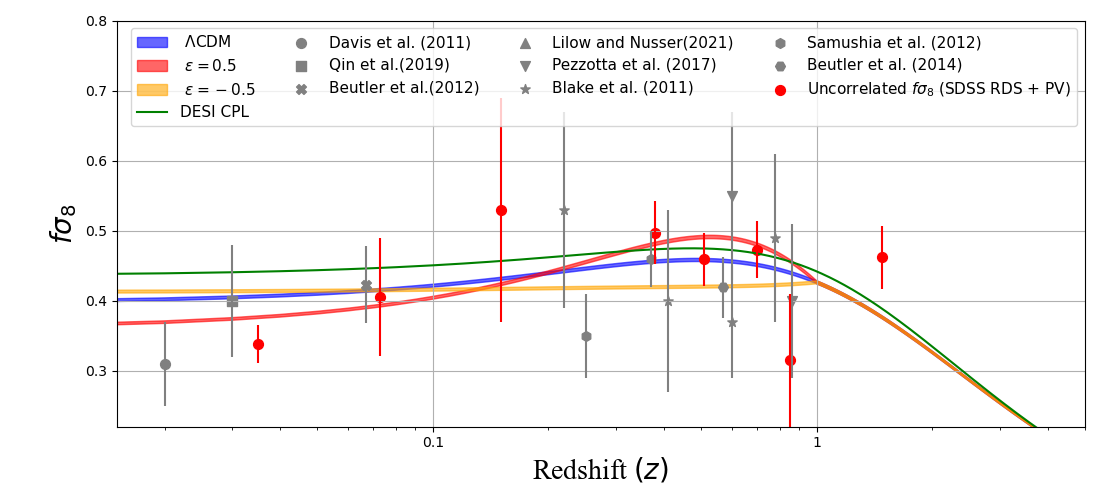
Predictions for the growth observable fσ8(z) in the matter-transition and CPL scenarios.

The recent preference for dynamical dark energy can also be reproduced without modifying dark energy itself. We showed that a simple late-time transition in the effective equation of state of matter fits DESI DR2 BAO, DESY5 supernovae and CMB distance data essentially as well as the standard CPL parametrization, with both models preferred over ΛCDM in the analysis. The two scenarios, however, predict different expansion and structure-growth histories, offering a way to distinguish them with future observations.

Redshift drift of gravitational lensing

O. F. Piattella and L. Giani, Redshift drift of gravitational lensing, Phys. Rev. D 95 (2017) 101301.

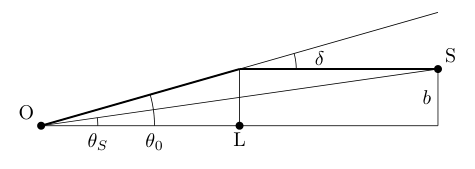
Strong-lensing geometry used to describe the angular and time-delay drifts.

Cosmic expansion changes observable quantities not only across space, but also with time. We showed that in a strong gravitational lens the cosmological redshift drift induces both a slow change in the apparent angular positions of the images and a drift in their relative time delay. These effects provide, in principle, alternative real-time probes of the Hubble expansion at the lens redshift, although their expected magnitude is extremely small: about 10⁻¹⁰ arcsec per year for the angular drift and 10⁻³ seconds per year for the time-delay drift in a representative system.

Lensing in the McVittie metric

O. F. Piattella, Lensing in the McVittie metric, Phys. Rev. D 93 (2016) 024020; Erratum: Phys. Rev. D 93 (2016) 129901.

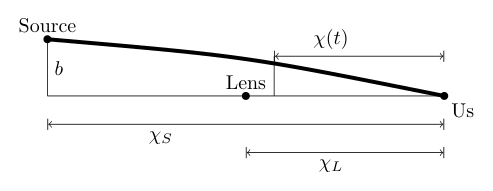
Lensing geometry for a point mass embedded in an expanding cosmological background.

Does the expansion of the Universe modify the bending of light by an isolated mass? Using the McVittie metric to embed a point-like lens consistently in an expanding cosmological background, we obtained an analytic perturbative treatment of the problem. Once cosmological distances are treated consistently, the apparent expansion-dependent contribution is absorbed into the usual lensing geometry: at leading order, no additional cosmological correction to the bending angle remains.

Curriculum vitæ

Academic curriculum

Academic positions, fellowships, teaching, supervision and publications.

Research profiles

Publication records and research metrics.

Selected publications & preprints

  1. D. Campanella Galanti and O. F. Piattella, Partial geometrization of dark matter in metric f(R) gravity: Exact reconstruction and growth constraints, arXiv:2610.30201 (2026).

  2. G. Bianchi, F. Re and O. F. Piattella, Dark Coriolis fields, Eur. Phys. J. Plus 141 (2026) 275.

  3. A. Ghazale and O. F. Piattella, More on the relativistic images produced in gravitational lensing, arXiv:2512.00139 (2025).

  4. L. Giani, R. von Marttens and O. F. Piattella, The matter with(in) CPL, Open J. Astrophys. 8 (2025), DOI: 10.33232/001c.142699.

  5. F. Re and O. F. Piattella, Non-Zero Coriolis Field in Ehlers’ Frame Theory, Galaxies 13 (2025) 38.

  6. F. Scali and O. F. Piattella, Asymptotically Schwarzschild solutions in f(R) extension of general relativity, Phys. Rev. D 110 (2024) 064042.

  7. L. Giani and O. F. Piattella, Induced non-local cosmology, Phys. Dark Univ. 40 (2023) 101219.

  8. P. Bessa and O. F. Piattella, Gravitational lensing in a universe with matter and a cosmological constant, Phys. Rev. D 106 (2022) 123513.

  9. L. Giani, E. Frion and O. F. Piattella, Impact of inhomogeneities on slowly rolling quintessence: implications for the local variations of the fine-structure constant, Class. Quant. Grav. 38 (2021) 175010.

  10. O. F. Piattella, Does the cosmological constant stay hidden?, Phys. Rev. D 102 (2020) 104039.

  11. M. Wittner, G. Laverda, O. F. Piattella and L. Amendola, Transient weak gravity in scalar-tensor theories, JCAP 07 (2020) 019.

  12. O. F. Piattella, Lecture Notes in Cosmology, UNITEXT for Physics, Springer (2018), DOI: 10.1007/978-3-319-95570-4.

  13. T. Miranda, J. C. Fabris and O. F. Piattella, Reconstructing a f(R) theory from the α-Attractors, JCAP 09 (2017) 041.

  14. O. F. Piattella and L. Giani, Redshift drift of gravitational lensing, Phys. Rev. D 95 (2017) 101301.

  15. O. F. Piattella, Lensing in the McVittie metric, Phys. Rev. D 93 (2016) 024020; Erratum: Phys. Rev. D 93 (2016) 129901.

  16. J.-c. Hwang, H. Noh, J. C. Fabris, O. F. Piattella and W. Zimdahl, Newtonian hydrodynamic equations with relativistic pressure and velocity, JCAP 07 (2016) 046.

  17. D. Wands, O. F. Piattella and L. Casarini, Physics of the Cosmic Microwave Background Radiation, Astrophys. Space Sci. Proc. 45 (2016) 3.

  18. O. F. Piattella, J. C. Fabris and N. Bilić, Note on the thermodynamics and the speed of sound of a scalar field, Class. Quant. Grav. 31 (2014) 055006.

  19. O. F. Piattella, D. C. Rodrigues, J. C. Fabris and J. A. de Freitas Pacheco, Evolution of the phase-space density and the Jeans scale for dark matter derived from the Vlasov-Einstein equation, JCAP 11 (2013) 002.

  20. A. A. Grib, Y. V. Pavlov, and O. F. Piattella, High energy processes in the vicinity of the Kerr's black hole horizon, Int. J. Mod. Phys. A 26 (2011) 3856.

  21. O. F. Piattella, J. C. Fabris and W. Zimdahl, Bulk viscous cosmology with causal transport theory, JCAP 05 (2011) 029.

  22. O. F. Piattella, D. Bertacca, M. Bruni and D. Pietrobon, Unified Dark Matter models with fast transition, JCAP 01 (2010) 014.

  23. O. F. Piattella, The extreme limit of the generalized Chaplygin gas, JCAP 03 (2010) 012.

  24. V. Gorini, A. Y. Kamenshchik, U. Moschella, O. F. Piattella and A. A. Starobinsky, Gauge-invariant analysis of perturbations in Chaplygin gas unified models of dark matter and dark energy, JCAP 02 (2008) 016.
Publication lists & documents

My PhD thesis was published by LAP Lambert Academic Publishing, ISBN 978-3-8443-8842-8.

Research codes

Mathematica notebooks used in some of my papers, together with the data they read and a README with instructions. They are released under the MIT license; please cite the corresponding paper. The supernova data belong to their original authors.

Neutron stars in R² gravity

Static neutron stars in f(R) = R + αR² gravity with the SLy, BSk19 and BSk20 equations of state: shooting method, mass–radius relations and five inequivalent definitions of mass, compared with General Relativity.

F. Sbisà, P. O. Baqui, T. Miranda, S. E. Jorás and O. F. Piattella, Neutron star masses in R²-gravity, Phys. Dark Univ. 27 (2020) 100411.

Supernova likelihood in wCDM

Grid-based Bayesian analysis of type Ia supernovae in flat wCDM, with analytic marginalisation over H₀, credible regions and marginal probability densities. Developed for the Union2.1 compilation; it is the template for the model-specific analyses below.

Rastall cosmology

Supernova constraints from the Constitution set and evolution of matter perturbations in Rastall's theory of gravity.

C. E. M. Batista, J. C. Fabris, O. F. Piattella and A. M. Velasquez-Toribio, Observational constraints on Rastall's cosmology, Eur. Phys. J. C 73 (2013) 2425.

Viscous dark matter

Supernova likelihood for a bulk-viscous dark component with viscosity ξ = ξ₀ρν, with credible regions and marginal probability densities.

C. M. S. Barbosa, J. C. Fabris, O. F. Piattella, H. E. S. Velten and W. Zimdahl, Viscous Cosmology, arXiv:1512.00921 (2015).