Teaching & research material
Teaching
Current courses, lecture notes, seminar presentations and research resources in cosmology, gravitation and mathematical physics.
Current courses
Courses I currently teach at the Università degli Studi dell’Insubria, Como.
Gravitation and Cosmology
Metodi matematici per la fisica (Mathematical Methods for Physics)
Fisica A (Physics A, taught in Italian): lecture notes (PDF, in Italian, updated during the course) and interactive animations
Lecture Notes in Cosmology
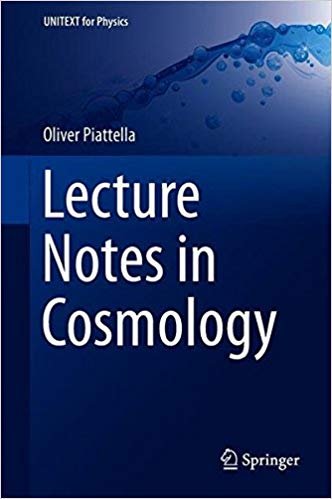
First published with Springer in 2018, these notes grew out of my cosmology teaching. An extended, updated and corrected version is available on arXiv and forms the basis of the forthcoming second edition.
Topics include the expanding Universe, thermal history, cosmological perturbations, Boltzmann equations, initial conditions, stochastic perturbations, inflation, and cosmic microwave background temperature and polarisation anisotropies.
Scientific seminars
May 2025: The equation of state of matter and the Hubble tension, Bilkent Applied Mathematics Online Seminars
September 2022: Enhanced Recombination and the Hubble tension, VI Escola José Plínio Baptista, Pedra Azul, Espírito Santo, Brazil
June 2022: Enhanced Recombination and the Hubble tension, Estate Quantistica 2022, Scalea, Italy
April 2022: Does the cosmological constant stay hidden?, Cosmosur VI (online)
September 2020: Review of the cosmological constant problem, GravBR initiative seminar (online)
July 2020: About the hiding of the cosmological constant, Cosmology group seminar, Heidelberg University ITP, Germany (online)
December 2018: The effect of the cosmological constant on the bending of light, Cosmology group seminar, Heidelberg University ITP, Germany
November 2017: Gravitational Lensing, colóquio do PPGFis, Vitória, Espírito Santo, Brazil
September 2017: Gamma, Zeta and prime Numbers, PPGCosmo Colloquium, Vitória, Espírito Santo, Brazil
May 2017: Introdução à Cosmologia, colóquio do PPGFis, Vitória, Espírito Santo, Brazil
September 2015: Lensing in the McVittie metric, ICG seminar, Portsmouth, UK
March 2012: The cosmic microwave background radiation and the integrated Sachs-Wolfe effect, colóquio do PPGFis, Vitória, Espírito Santo, Brazil
April 2011: Scattering of particles near a rotating black hole, Cosmology group seminar, UFES, Espírito Santo, Brazil
November 2010: Causal Bulk Viscous Cosmology - Bulk Viscosity as Unified Dark Matter, CBPF seminar, Rio de Janeiro, Brazil
Lectures
June 2024: Introduction to Cosmology, Estate Quantistica, Scalea, Italy (here Part 2 and Part 3)
September 2022: Lenteamento Gravitacional, Inverno Astrofísico, Domingos Martins, Espírito Santo, Brazil
September 2022: Introdução à gravitação, Inverno Astrofísico, Domingos Martins, Espírito Santo, Brazil
July 2019: Lectures on the cosmological constant, Block course, Heidelberg University ITP, Germany
July 2018: Introduction to Gravitational Waves, Inverno Astrofísico 2018, Castelo, Espírito Santo, Brazil
April 2017: Introdução à Cosmologia. 3 lectures delivered at Primeira Escola de Ciências Físicas Brasil-Cabo Verde (here Lecture 2 and Lecture 3)
Outreach seminars
February 2025: Einstein e la Relatività, Outreach seminar, Varese
September 2022: Introdução à Cosmologia, Universo no parque, Vitória, Espírito Santo, Brazil
Teaching collaborations
Qui Si Risolve
In summer 2026 I wrote for Qui Si Risolve, an Italian online platform of solved problems and theory in mathematics and physics, the booklet Elettricità e magnetismo 1 – Carica elettrica, forza di Coulomb e campo elettrico (in Italian): forty exercises with commented solutions and a review of the theory, prepared for the 2026/2027 semestre aperto.
CosmoVerse · Teaching the Universe
Within the CosmoVerse COST Action CA21136, I translated into Italian, with Matilde Signorini, Teaching the Universe: six cosmology lessons for secondary-school teachers (students aged 14–18) on the Big Bang, the Hubble–Lemaître law, cosmic redshift, geometric gravity, dark matter and dark energy. Each lesson combines a lesson plan based on the 5E model with a dialogue between teacher, students and famous scientists.
Research resources
Geodesics in Black-Hole Spacetimes
A monograph on arXiv (2026, 82 pages) that classifies geodesics in Schwarzschild, Kerr and Schwarzschild–de Sitter spacetimes without solving for the turning points: the qualitative behaviour of each orbit is read directly from the coefficients of the radial and polar polynomials, using Vieta’s formulas. Written for graduate students who have taken a first course in general relativity, with worked examples at the end of each chapter.